For most bettors the app has replaced the shop and the desktop site as the place money actually moves. That makes it the right place to think about two things at once: how easily you can control your spending, and how well your funds and card data are protected. A polished interface is no guarantee of either, so this guide reads the app through its money features and its security, then sets out the complaints route for when something goes wrong.
The regulatory backdrop is the same on a phone as anywhere else. The operator must hold a UK Gambling Commission licence, must offer the safer-gambling tools, and must give you a proper complaints process ending, if needed, at an approved dispute resolution provider. What the app changes is how quickly you can deposit, which is exactly why the controls below are worth setting up first.
01
Apps compared with the mobile site
A native app and the operator's mobile website usually offer the same account, the same balance and the same markets; the differences are in convenience and control. An app can log you in with a fingerprint or face check, send notifications and work a little faster, while the mobile site needs nothing installed and leaves no gambling app on your home screen. Neither is inherently safer for your money, because both are governed by the same licence and the same banking rules.
From a spending point of view the app's speed cuts both ways. Biometric login and one-tap deposits remove friction, which is convenient when you are in control and unhelpful when you are chasing. If you find the ease of depositing a problem, the mobile site, with its extra steps, or a deposit limit set low, can be a deliberate brake. Choose the version that fits how you actually behave, not the one with the slickest launch screen.
02
Managing your money inside the app
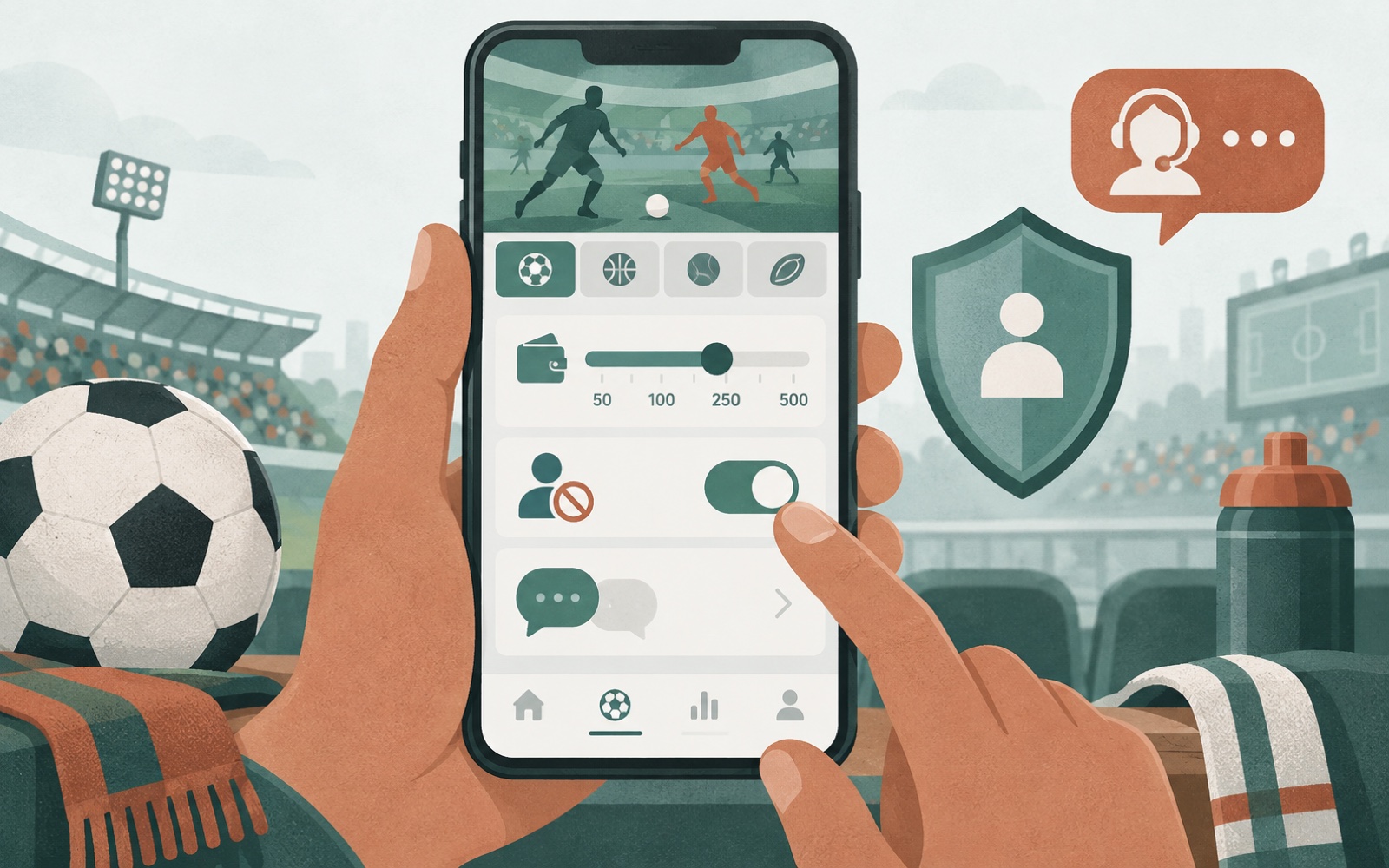
The features that matter most are the ones that show and cap the money. A deposit limit, set daily, weekly or monthly, is the single most effective control an app offers, and by rule any increase only takes effect after a cooling-off period while a decrease applies at once. Set one before you play rather than after a heavy session, and treat it as a budget, not a target.
Alongside limits, use the transaction history. It lists deposits, withdrawals and adjustments, and reading it is the only reliable way to know your true net position, which the headline balance never tells you. Reality-check reminders can interrupt a long session with the time elapsed and the amount staked, and a time-out lets you lock yourself out for a short period without the finality of self-exclusion. A well-built app puts all of these within a tap or two of the account menu.
A common example
Suppose you set a £50 monthly deposit limit and, three weeks in, feel like topping up. The app will refuse the deposit above the limit and offer to raise it, but the higher figure will not apply until after the cooling-off period, giving you a pause to reconsider. That built-in delay is doing exactly what it should, turning an impulse into a decision you make with a clear head the next day.
03
Payment security, 2FA and card storage
Because an app can hold a saved payment method and a logged-in session, its security is really the security of your money. Protect the account with a strong, unique password and turn on two-factor authentication, so a stolen password alone cannot reach your funds. Use the device's biometric or passcode lock to open the app, and avoid staying logged in on a shared or public device.
On payments, remember that credit cards have been banned for gambling across Great Britain since April 2020, so any app still offering a credit-card deposit is a serious red flag. Debit cards, bank transfer and open banking are the lawful routes. If you would rather not leave card details stored, open banking and e-wallets let you deposit without keeping a card on file, which also limits what is exposed if the account is ever compromised. A legitimate app never asks you to move funds through vouchers or crypto wallets to receive a payout.
| What to check | Why it matters | Where |
|---|---|---|
| UKGC licence | Legal to serve UK, dispute route | Public register |
| Two-factor login | Protects a saved card and balance | Account security |
| Deposit limits | Caps spending before a session starts | Account settings |
04
Customer support and response times
Good support is measured by how it behaves when money is due out, not when you are putting money in. Live chat on a well-run app tends to answer within minutes, phone lines during stated hours, and email within a working day or two. Look for a clear, findable route to a human being rather than a loop of automated menus, and note whether the help centre explains withdrawals and verification plainly.
The telling test comes at withdrawal. If support is quick and friendly while you deposit but slow, scripted or silent when you ask to be paid, that asymmetry is itself a finding. Keep a short record of who you spoke to and when, because a timeline of contact is exactly what an approved dispute resolution provider will want if a complaint has to go further.
Key points
- Turn on two-factor authentication and a device lock before saving any card; credit-card deposits are banned, so debit, open banking or e-wallet only.
- Set a deposit limit and read the transaction history rather than trusting the headline balance; increases only apply after a cooling-off period.
- Complain to the operator first, then escalate to a UK Gambling Commission approved ADR such as IBAS; the Commission does not settle individual disputes. Free support is always available from BeGambleAware.
05
Making a complaint that gets heard
Every licensed operator must have a complaints procedure, and using it correctly gives you the strongest position. Put the complaint in writing through the app's official channel, state clearly what happened and what you want, and quote references, the account name, the bet or transaction ID, dates and amounts. Keep copies of everything, including chat transcripts and emails, because a clear paper trail decides most cases.
The operator should acknowledge the complaint and work towards a final response, and by rule the process should conclude within eight weeks. If they uphold it, the money is returned to your balance and you can withdraw as normal. If they reject it, or the eight weeks pass without a final answer, you have the right to take the matter to an independent adjudicator, which is where the next step comes in.
A common example
Say a withdrawal is frozen and support cites a verification issue you believe you have already cleared. You send a written complaint quoting the withdrawal reference and the documents you submitted, with dates. If the operator's final response still refuses to pay, you have both the timeline and the evidence ready to hand to an approved dispute resolution provider, which can review the case without you paying a fee.
06
Dispute resolution and IBAS
Alternative dispute resolution, or ADR, is a free, independent service that reviews complaints once the operator's own process is exhausted. Every UK Gambling Commission licensee must be signed up to a Commission-approved ADR provider, and for betting the best known is the Independent Betting Adjudication Service, IBAS. You submit your evidence, the operator submits theirs, and the provider issues a decision the operator has agreed to be bound by.
ADR handles disputes about facts and transactions, such as a settled bet, a withheld balance or a bonus dispute, rather than complaints about the law or general conduct. It cannot award compensation beyond the money at stake, and it is not a route for appealing a fair result you simply dislike. Used properly, though, it is the mechanism that can actually rule that an operator must pay, which is why the written trail from the previous step matters so much. We name IBAS here as an example; check your operator's terms for the specific provider it uses.
07
The regulator and the coming ombudsman
It is a common misunderstanding that the Gambling Commission will step in and recover your money. It will not. The Commission licenses and regulates operators, sets the conditions they must follow and can act against a firm for breaching them, but it does not settle individual disputes or order a payout to a specific customer. Reporting a problem to the Commission still has value, because patterns of complaints inform its enforcement, but it is not your route to redress on a single bet.
That gap is due to narrow. The Government's 2023 gambling White Paper proposed a statutory Gambling Ombudsman to give consumers a single, binding route for complaints about how an operator has treated them, sitting above the current ADR system. Until it is fully established, the operator-first, then approved-ADR path remains the way to pursue a withheld payment, and the Commission's register remains the way to confirm you are dealing with a licensed firm in the first place.
Related reading on this site
- How to choose a betting site in the UK
- How to check a betting site's UKGC licence
- Understanding odds, markets and value
- Deposits, withdrawals and the credit-card ban
- Safer gambling tools and GAMSTOP
- Warning signs of an unsafe betting site
- Bet types, accumulators and cash out
How we check our facts
The complaints and licensing detail here follows guidance published by the Gambling Commission, including its position that it does not settle individual disputes, together with the 2023 gambling White Paper's proposal for a Gambling Ombudsman. Support information reflects the free services run by GamCare. Last checked 25 September 2026.

Frequently asked questions
Is it safe to save my card details in a betting app?
It can be, provided the card is a debit card, since credit cards have been banned for gambling since April 2020, and provided the app protects the account with a strong password and two-factor authentication. A saved card is only as safe as the login guarding it, so turn on 2FA, use a biometric or device passcode to open the app, and never store details in an app you cannot find on the UK Gambling Commission public register. If you would rather not store a card at all, open banking and e-wallet options let you deposit without leaving card data on file.
How can I keep track of what I am spending inside an app?
Every licensed app must give you deposit limits, and setting a daily, weekly or monthly cap is the single most effective control; any increase only takes effect after a cooling-off period. Use the transaction history to see deposits, withdrawals and net position rather than relying on the headline balance, set reality-check reminders during a session, and consider a time-out if you need a short break. Keeping your own note alongside the app's history means a bank statement never surprises you.
How long should customer support take to answer a payment query?
Live chat on a well-run app usually responds within minutes, and email within a working day or two. What matters most is that support stays responsive when money is due out, not just when you are depositing. If replies dry up the moment you request a withdrawal, or you are pushed round automated menus with no route to a person, treat that as a warning sign about how the operator handles funds.
Who do I complain to if an operator withholds my money?
Complain to the operator first, in writing, and keep a record. If you are not satisfied with their final response, or eight weeks pass without one, refer the dispute to a UK Gambling Commission approved alternative dispute resolution provider such as IBAS, which reviews betting complaints free of charge. The Gambling Commission does not settle individual disputes or recover money for you. A statutory Gambling Ombudsman, proposed in the 2023 gambling White Paper, is expected to take on consumer redress in future.