
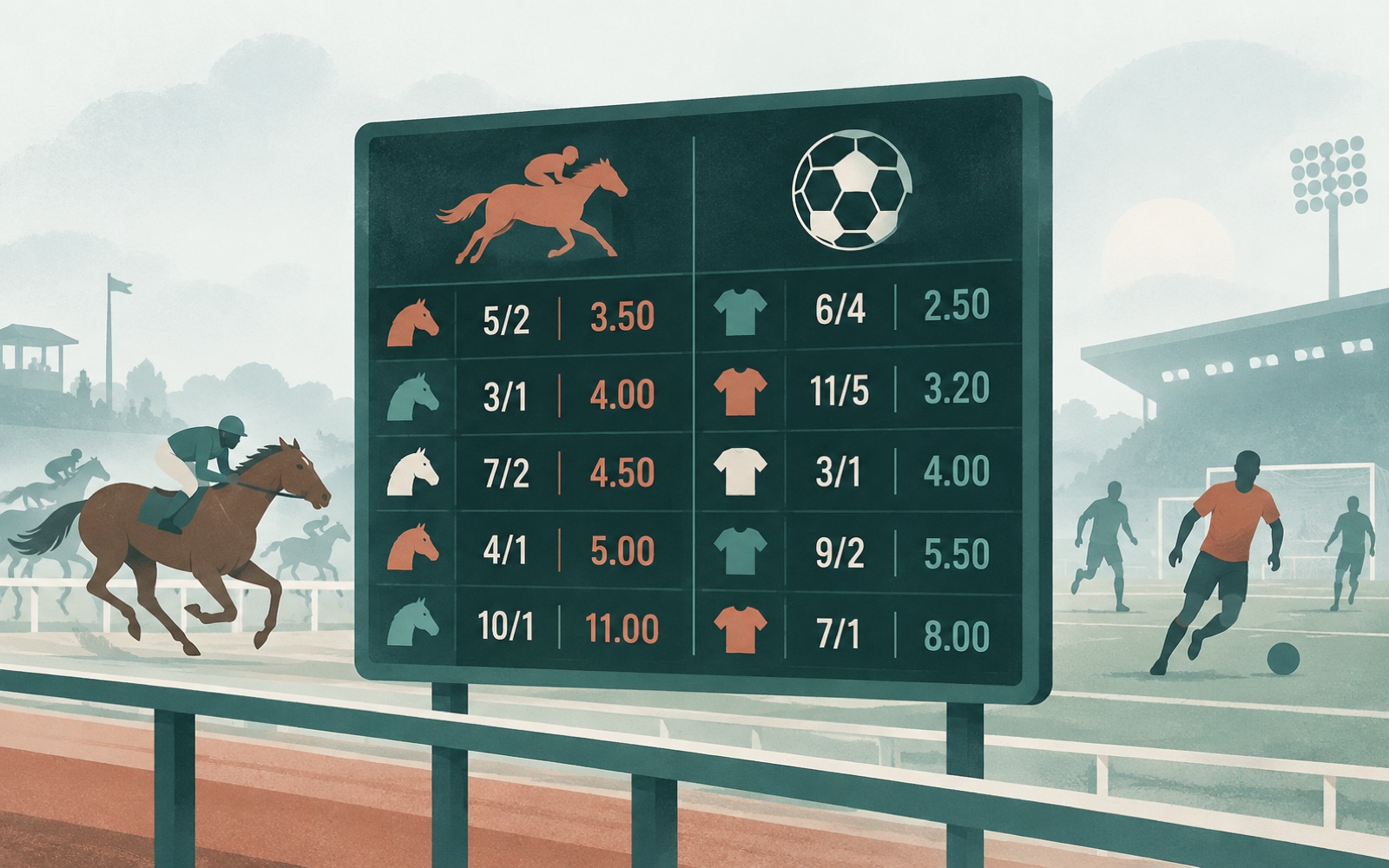
Odds can look like a language of their own, but they are simply prices, and a price always includes the seller's cut. Read them that way and the mystery falls away. What looks like a generous line is often a modest one once you account for the margin, and what looks like value beside a bonus can be worth less than a plain price paid in cash.
This is a numerate, no-hype guide. It covers how odds are written, how to convert between formats, how the margin works, why comparing prices pays over time, and where promotions quietly distort the real cost of a bet. The aim is to help you judge value in money you can actually withdraw.
01
How betting odds are written and read
Odds express two things at once, the return on a winning bet and the chance the book assigns to the outcome. In the UK you will see fractional odds such as 5/1 and decimal odds such as 6.0, and increasingly you can switch between them in your account settings. Whichever you use, the underlying price is identical; only the notation changes.
The quickest mental model is to turn a price into an implied probability. A price of 2.0 decimal, or evens, implies a 50% chance. A price of 4.0, or 3/1, implies 25%. Reading odds as probabilities lets you ask the only question that matters: do you think the real chance is better than the price suggests?
02
Fractional, decimal and the same real price
Fractional odds show profit relative to stake, so 2/1 returns £20 profit on a £10 bet, plus your £10 back, for £30 in total. Decimal odds fold the stake in, so the same bet is 3.0 and a £10 stake returns £30. To convert, add one to a fraction expressed as a decimal: 2/1 is 2.0 plus 1, which is 3.0; 4/5 is 0.8 plus 1, which is 1.80.
Neither format is better value than the other, and a site cannot dodge this by quoting one rather than the other. Pick the notation you read most easily and stick with it, because consistency helps you compare prices quickly across markets and across sites.
A worked conversion
You see 7/4 on one screen and 2.75 on another. Are they the same? 7 divided by 4 is 1.75, plus 1 is 2.75. They are identical. A £20 bet returns £55 in total either way. Being able to check this in your head stops a familiar-looking fraction from disguising a shorter price.
03
The margin, or how the book keeps its cut
Bookmakers build a margin, the overround, into every market so that the implied probabilities add up to more than 100%. In a fair two-way market each side would be 2.0, totalling exactly 100%. In a real market you might see 1.90 and 1.90, whose implied probabilities total around 105%, and that extra five points is the book's edge.
The margin is why the odds favour the book over time, and it varies between sites and between markets. Popular, liquid markets tend to carry tighter margins; niche markets carry wider ones. Learning to estimate the overround tells you how much of your stake is being taken before any result is known.
| What to check | Why it matters | Where |
|---|---|---|
| UKGC licence | Legal to serve UK, dispute route | Public register |
| Safer-gambling tools | Limits, time-outs, self-exclusion | Account settings |
| Payment terms | Debit only, clear withdrawal times | Banking page |
04
Comparing prices and why it pays you back
Because the margin varies, the same selection is priced differently across sites, and consistently taking the better line is one of the few genuine edges a bettor has. A difference between 2.75 and 2.90 looks small, but repeated over hundreds of bets it is the gap between a slow bleed and something closer to break-even before the margin.
Compare the whole deal, though, not just the number. A marginally better price at a site that pays slowly, verifies only at cash-out or wraps the bet in a bonus is not the better value. The price you should care about is the one attached to money you can actually withdraw, as our payments guide explains.
Key points
- Fractional and decimal odds are the same price written two ways; convert by adding one to the fraction as a decimal.
- Every market carries an overround above 100%, and that margin is the book's cut, so lower is better value for you.
- A bonus price is only worth the cash you can withdraw; from 19 January 2026 wagering requirements are capped at 10x the bonus.
05
Markets, in-play and bet builders
Beyond the main result, sites offer dozens of markets: over and under lines, both teams to score, player specials and more. Bet builders combine several of these into one bet at a single price. They can be entertaining, but each added leg compounds the margin, so a builder often carries a much larger overround than any single selection within it.
In-play betting moves fast, and prices update as events unfold. That speed makes it easy to stake more than you intended, which is one reason a deposit limit set in advance matters. Treat exotic markets and builders as the higher-margin, higher-variance corner of the book, and size any stake accordingly.
06
Value, discipline and sizing your stake
Value means backing a selection at a price longer than its true chance, and it is far rarer than confident tips suggest. Even with an edge, staking discipline decides whether you keep it. Fixed, modest stakes protect you from a bad run wiping out a bankroll, while chasing losses with larger bets is the fastest route to ruin.
Remember the structural facts. The margin favours the book, winnings are tax-free but that does not make betting profitable, and no staking system overcomes a negative expectation. Discipline is not about winning more; it is about keeping losses within a budget you set on purpose, which is the sane way to treat any form of paid entertainment.
07
Where promotions hide the real price
Promotions are marketing, and their job is to make a price look better than it is. A boosted price tied to a wagering requirement locks up money you cannot withdraw until conditions are met, and free bets usually return winnings without the stake, quietly shortening the real return. From 19 January 2026 wagering requirements are capped at 10x the bonus and mixed sportsbook-and-casino offers are banned, which helps, but the arithmetic still needs checking.
Strip the offer away and price the bet on its own terms. If it stands up as value at the plain price, the promotion is a bonus. If it only looks good because of the offer, you are being sold the wrapper, not the bet. Reading the terms of a promotion the way you would read a payments page is the habit that protects your money.
Related reading on this site
- A step-by-step method for picking a site
- Confirming a licence on the UKGC register
- Deposits, withdrawals and the credit-card ban
- Deposit limits, GAMSTOP and support
- Payment red flags and unsafe sites
How we check our facts
The arithmetic here is standard, and the rules cited, the 10x wagering cap and the ban on mixed-product promotions from 19 January 2026, follow the Gambling Commission's published changes. Support information reflects the free services run by GamCare. Last checked 25 September 2026.

Frequently asked questions
Are fractional and decimal odds ever different prices?
No, they are two ways of writing the same price. 2/1 fractional is 3.0 decimal, and 4/5 is 1.80. Decimal includes your stake in the figure, so a £10 bet at 3.0 returns £30 in total. Switch your account to whichever format you find clearer; the money returned does not change.
What is the overround and why does it matter to my money?
The overround is the margin built into a market. Convert every price to an implied percentage and add them up; a fair market would total 100%, but a book totals more, and the excess is its cut. The higher the overround, the worse the value, so comparing it across sites tells you where more of your stake is working for you.
Does a bigger bonus make the odds better value?
Rarely. A bonus with a wagering requirement, capped at 10x from 19 January 2026, ties up money you cannot withdraw until conditions are met. Judge value by the return you can actually take out, not the headline price beside an offer. A slightly shorter price that pays cash cleanly often beats a longer one wrapped in conditions.
Is comparing prices across sites really worth the effort?
Over time, yes. Small differences in price compound across many bets, so consistently taking a better line is one of the few edges available to a bettor. Weigh it against the whole picture, though: a marginally better price at a site that pays slowly or verifies at cash-out is not the better deal.